A campsite on the Illinois River can run five dollars a person. A cabin can run a hundred and ninety a night. Those numbers sound like an easy decision until you put four people, a weekend and a rainstorm into the math.
Here is what camping and cabins actually cost along Highway 10 northeast of Tahlequah, Oklahoma, drawn from what the properties and the Grand River Dam Authority publish themselves.
Everything below is about the Illinois River in Cherokee County, Oklahoma — the Class I–II float corridor along Highway 10, not the river of the same name in the state of Illinois.
What does Illinois River camping cost in Oklahoma?
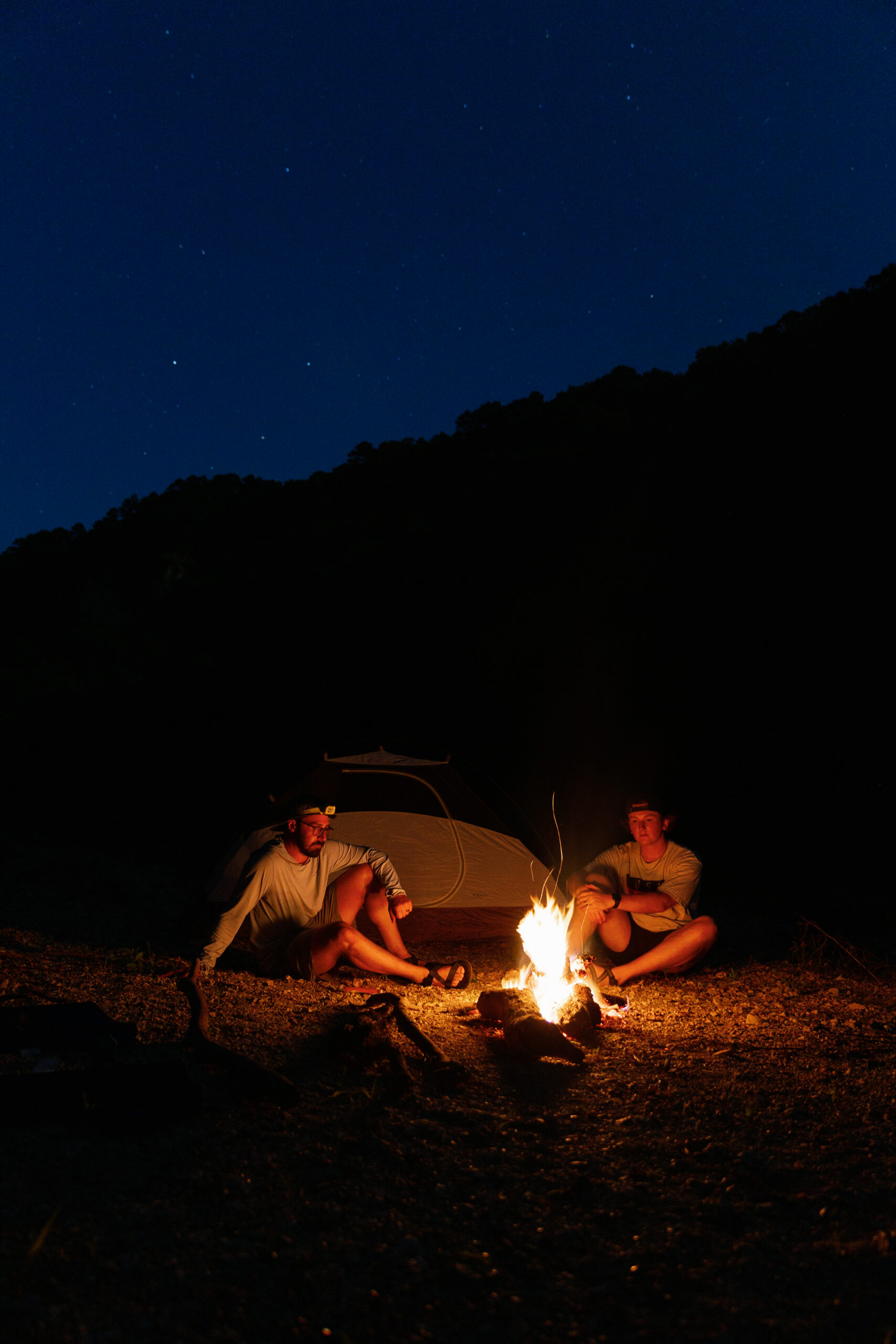
Public access areas — $14 per night. The Grand River Dam Authority charges $14 per campsite per night, covering no more than one adult tent, one child tent and two vehicles. Check-in is 3pm, check-out 1pm, and quiet hours run 10pm to 7am. Pets must be leashed, and fires belong in the designated rings, burn bans permitting.
The access areas sit at known river miles: Round Hollow (27.7), Stunkard (28.0), Peavine (32.4), Edmondson (36.2), No Head Hollow (41.5), Todd (47.0) and Echota (53.2). Round Hollow, Peavine, Edmondson and No Head Hollow permit beer and wine in original non-glass containers for adults 21 and over. Todd does not.
Private campgrounds — $5 to $49 per night. Diamondhead lists tent camping at $28 to $35 per site per night depending on hookups. Eagle Bluff Resort publishes the most granular ladder on the river: primitive camping $5 per person per night; a 30-amp site at $15 plus $8 per person; a 50-amp site at $20 plus $8 per person; a full-hookup RV site at $49 flat for up to six, then $9 per person; and glamping at $129 on weekdays. Rates exclude tax.
Illinois River Outfitters prices differently — $20 per vehicle per night for primitive tent camping, regardless of how many people are in the vehicle. For a full car, that is the lowest published camping cost on the river.
Arrowhead Resort, at river mile 32.5 on N. Hwy 10, has secluded tent camping and big RV spots, quoted by phone.
What does a cabin cost?
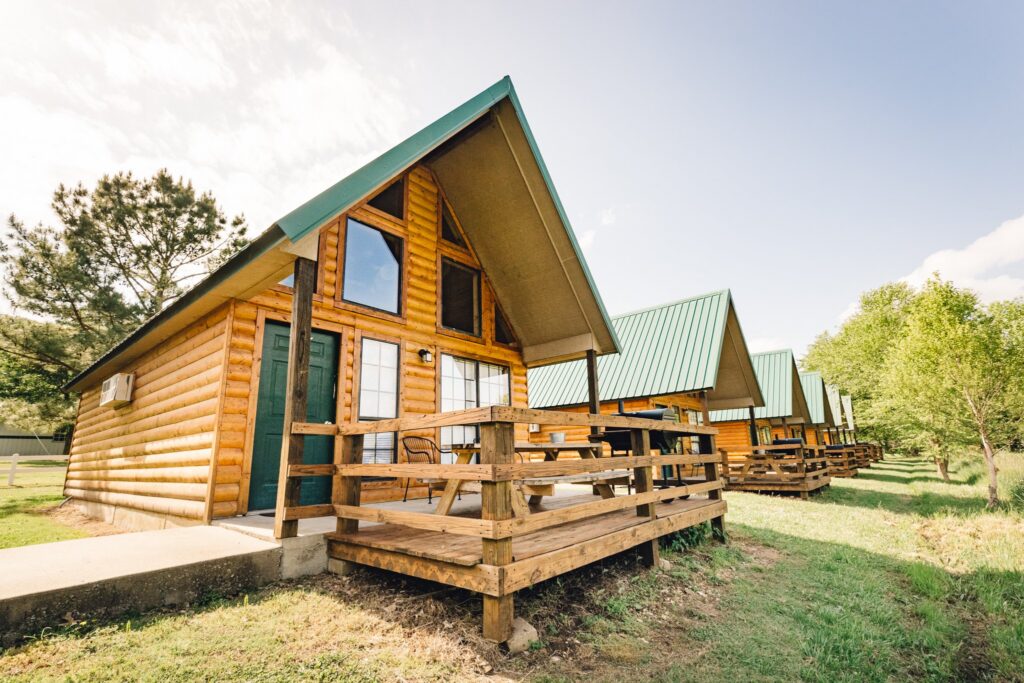
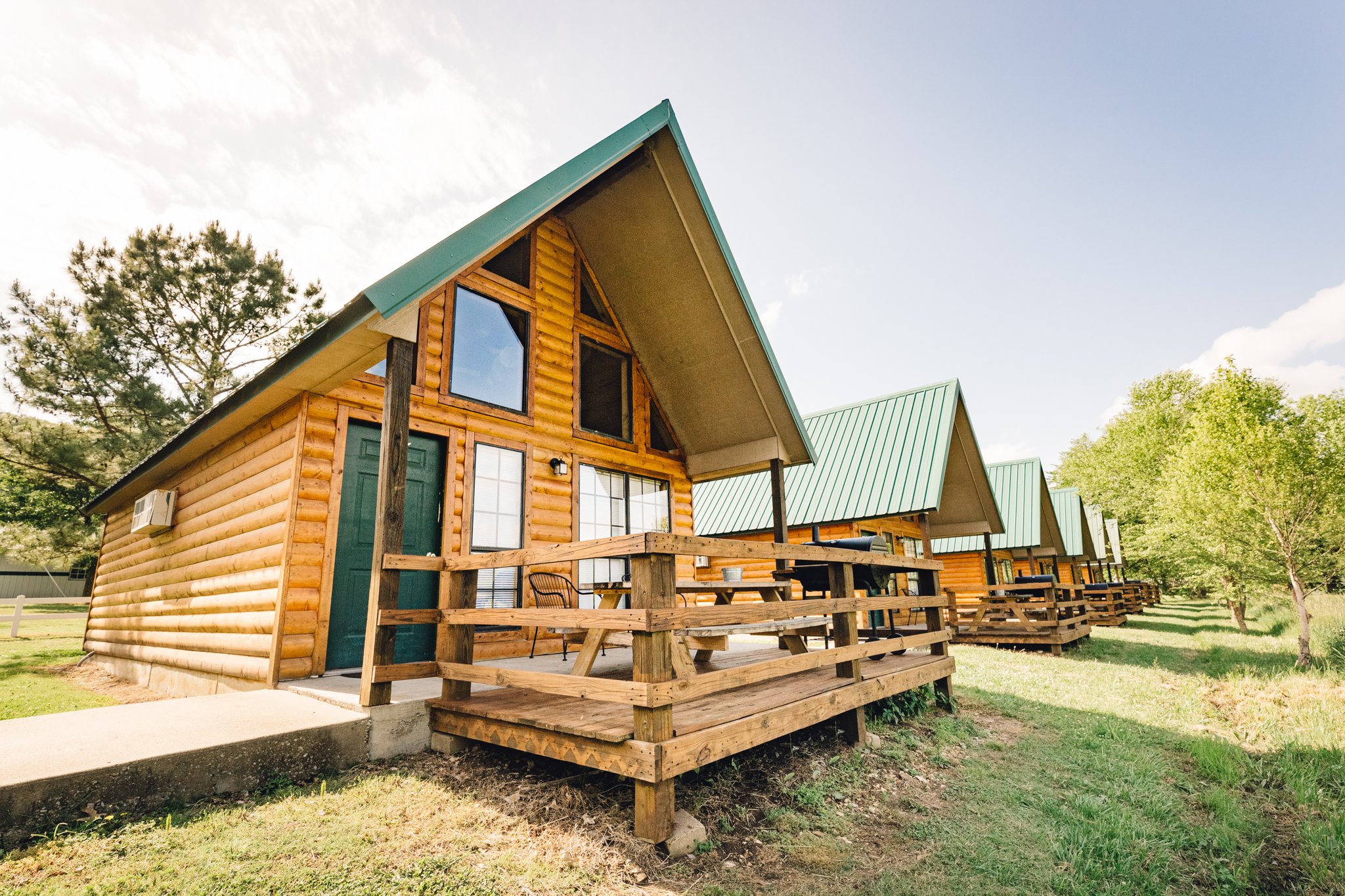
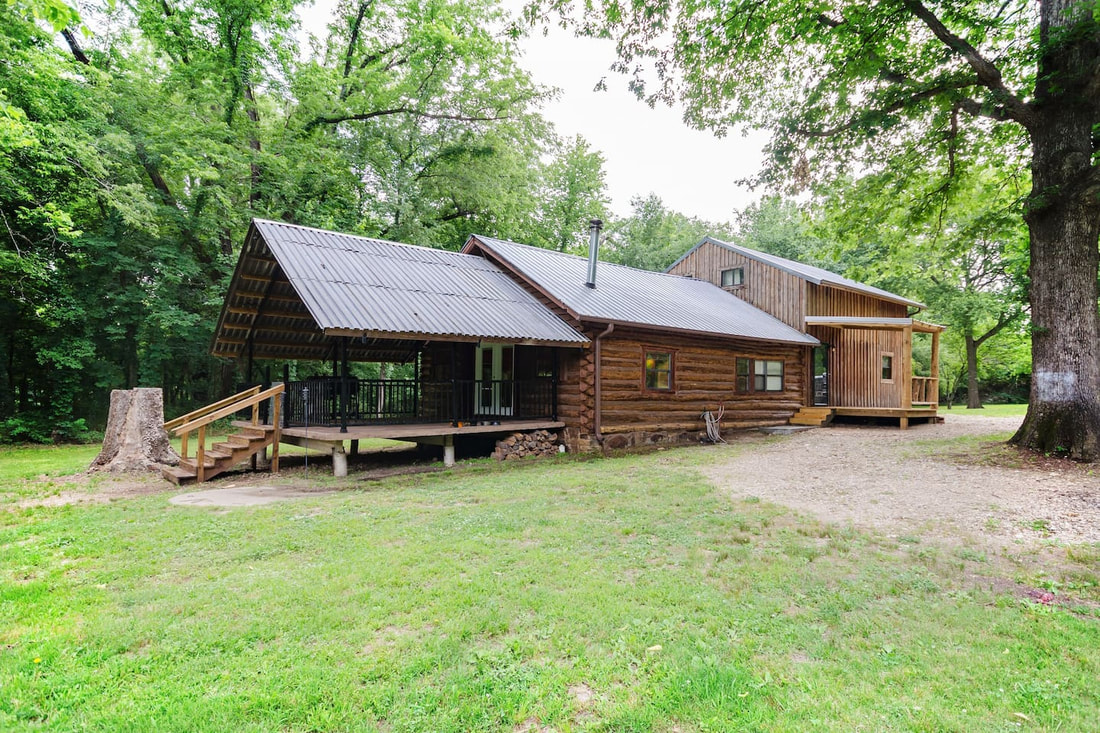
Illinois River Outfitters lists a two-bedroom log A-frame at $190 per night — one queen, one full, and a kitchen with fridge, stove, microwave and coffee maker. That is the clearest published cabin rate on the river.
Three conditions matter as much as the number:
Everywhere else quotes by phone. Arrowhead lists cabins for 2 to 40 people, Peyton’s Place has a 48-bed group lodge plus air-conditioned cabins, War Eagle has two-bedroom A-frames alongside a motel and bunkhouses, and Diamondhead has cabins, motel rooms and a bunkhouse.
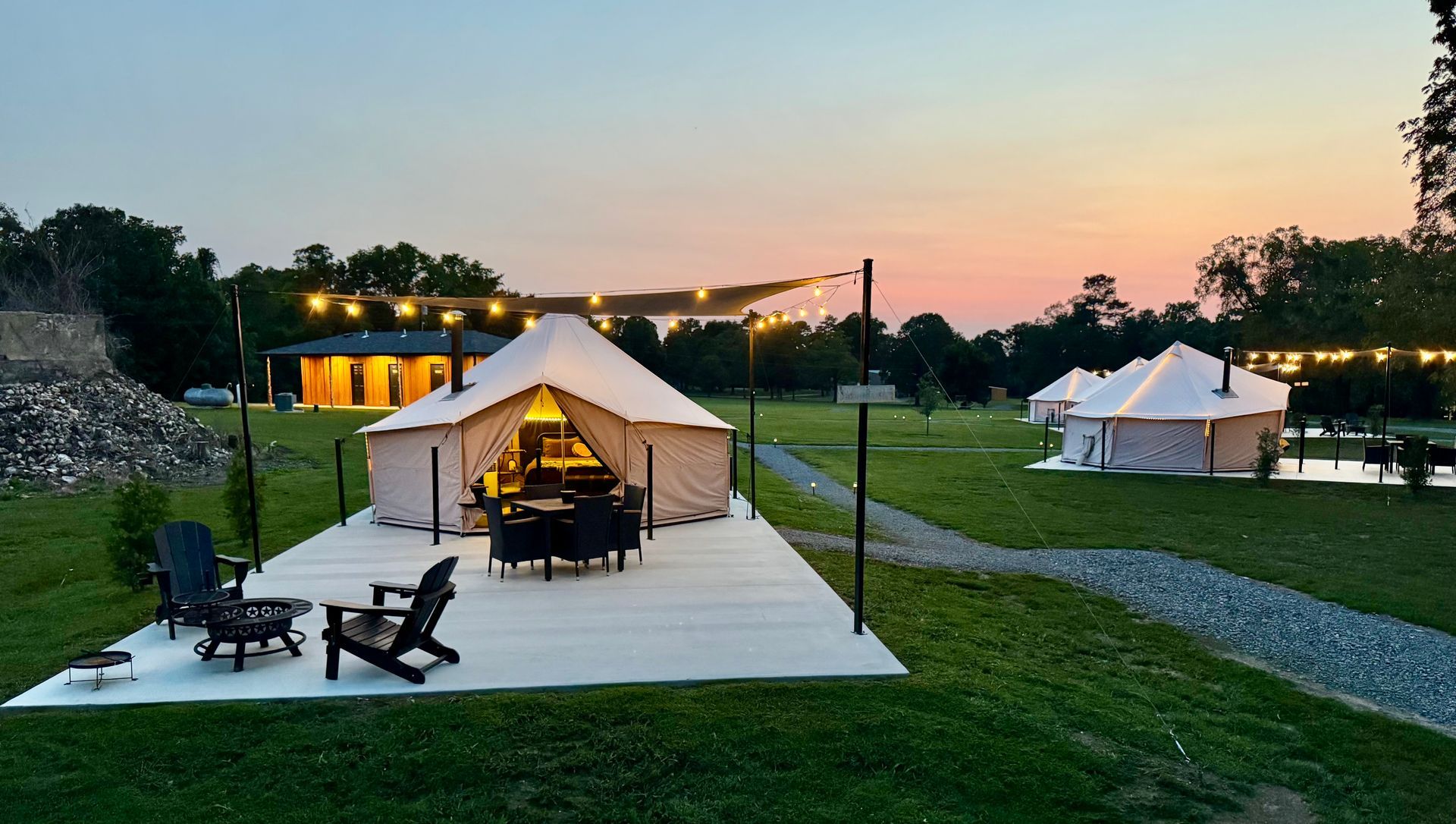
One option sits between the two: glamping. Eagle Bluff lists a site at $129 on a weekday, and The River Bluff Cabins has four — 18-foot canvas bell tents with air conditioning, a queen bed, a bunk cot, a wood stove, a mini fridge and a fire pit, with a full bathroom in a bath house about 100 feet away. You get a real bed without a cabin rate.
Camping or a cabin — where the math actually flips
Every figure below is published by the property or by GRDA.
| Party | Primitive camping | Cabin | Cheaper |
|---|---|---|---|
| 2 people, 1 night | $20 per vehicle (Illinois River Outfitters) or $10 (Eagle Bluff) | $190 — not available as one night on a weekend | Camping |
| 4 people, 1 night | $20 per vehicle or $20 | $190 | Camping |
| 4 people, 2 nights | $40 or $40 | $380 | Camping |
| 6 people in an RV, 1 night | $49 flat (Eagle Bluff full hookup) | n/a — the published cabin sleeps four | RV site |
| 8 people, 2 nights | $40 (two vehicles) or $80 | Two cabins, $760 | Camping |
Camping is cheaper at every party size on this river. The gap is not small either — at Diamondhead, where both sides are published, tent camping runs $28 to $35 a site while cabins are reported in the low hundreds. That is a difference of several times over, on the same property, for the same weekend.
The math does not flip at a larger party size, because the cabins that could theoretically flip it are the group lodges and bunkhouses, and those are quoted by phone rather than published. Anyone telling you a cabin saves money at six people is guessing.
What a cabin buys is not savings. It is a roof when the forecast turns, a real bathroom, a kitchen, air conditioning in August, and no tent to pack. Those are worth paying for. Just be clear that you are paying for them.
There is also a floor most people miss: the weekend two-night minimum. A Saturday cabin trip is $380, not $190, and the first night is non-refundable. Camping has no such minimum.
Terms to know before you book
Primitive site — a tent spot with no electric, water or sewer. GRDA access areas are primitive: vault toilets, no showers.
Full hookup — an RV site with electric, water and sewer at the pad.
30 amp / 50 amp — the electrical service at an RV site. A 50-amp site carries more load, which matters if you run air conditioning.
Glamping — a furnished canvas tent with a real bed, priced between a campsite and a cabin.
Put-in — where you get on the water. Private vessels launch at Peavine (mile 32.4) or Round Hollow (mile 27.7).
Take-out — where you get off, usually the outfitter’s landing.
Shuttle — the bus ride between your car and the put-in, normally included in a rental.
River mile — distance downstream from the Oklahoma state line at mile 0.0. Every access area has one, and it is the most useful thing you can say on the phone.
PFD — personal flotation device, or life jacket. Children 12 and under are required by law to wear one.
Where are the campsites, and are there showers?
This is the question floaters ask most often. Here is what the properties state.
Showers are worth confirming by phone. Floaters name Peyton’s Place for its bathrooms and showers, and War Eagle for showers that are consistently clean.
What you give up camping — and what you don’t
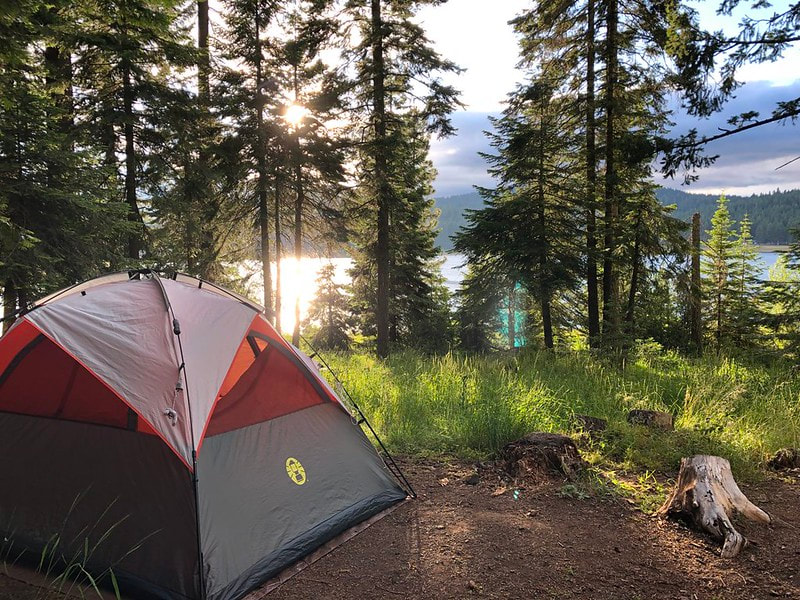
A tent gives you shelter, not weather protection. There is no climate control, your sleeping surface is whatever pad you brought, and the bathroom is shared where one exists at all. You also carry the logistics: gear in, gear out, food in a cooler that meets the size rule, and camp set up before anyone gets in the water.
What you keep is harder to buy back: you are on the river rather than near it, at a cost low enough that a second night is an easy yes.
What you’re paying for with a cabin
A cabin rate bundles shelter and comfort into one number. Here is what it covers.
| What you get | Cabin | Campsite |
|---|---|---|
| Climate control | Air conditioning | None |
| Sleeping surface | Furnished beds — the published A-frame has a queen and a full | Your own pad or air mattress |
| Cooking | Kitchen with fridge, stove, microwave and coffee maker | Fire ring or camp stove |
| Bathroom | Private | Shared bath house, or a vault toilet |
The published cabin has a kitchen but no cookware, so bring pots, pans and provisions. A cabin also takes the tent, pads and setup out of your packing list.
One honest note on expectations: these are working river-resort cabins, not boutique rentals. Most were built to house float groups, and they are priced accordingly. Ask to see current photos when you call rather than relying on a listing that may be a few seasons old.
How group size changes the math
Two to four people. The published cabin sleeps four across a queen and a full, at $190. Camping the same party runs $10 to $20 a night — $5 per person at Eagle Bluff, or $20 per vehicle at Illinois River Outfitters however many of you are in the car.
Six people. Eagle Bluff’s full-hookup RV site is $49 flat for up to six, the best per-person figure published on this river. Six primitive campers there pay $30.
Eight or more. The published cabin does not hold eight, so you are pricing two units by phone— or moving up to a bunkhouse, which is where the per-person math finally gets interesting. War Eagle’s rock house sleeps 16 and its bunkhouse sleeps 60; Peyton’s Place has a 48-bed group lodge with a meeting room, kitchen and fireplace; Arrowhead lists cabins for 2 to 40. For a reunion or a bachelor party, a bunkhouse split 20 ways can land below the cost of eight campsites, and everyone is under one roof. Get a per-person quote before you decide. The full cabin directory by river mile lists every option with its occupancy.
One more group note: GRDA limits a public-access campsite to one adult tent, one child tent and two vehicles — a limit on tents and vehicles, not on people. A larger group usually needs a second site at $14, so price two sites rather than assuming everyone fits under one fee.
Loud camp or quiet camp?
If you want quiet, floaters mention Peyton’s Place for staff who enforce quiet hours, and Riverside Camp at mile 27.5 as the northernmost camp on a less crowded stretch. GRDA access areas run official quiet hours from 10pm to 7am.
If you want the opposite, Diamondhead has a bar and live music, and floaters mention a stage at Falcon Floats or War Eagle hosting live music during the busy season.
Neither is wrong. Booking one when you wanted the other is, so ask before you reserve.
Camping with an RV
Nearly all sit on N. Hwy 10 between river miles 32 and 55, so “how far up Hwy 10” is useful shorthand when you call.
What will you be floating in?
The craft decides who can come.
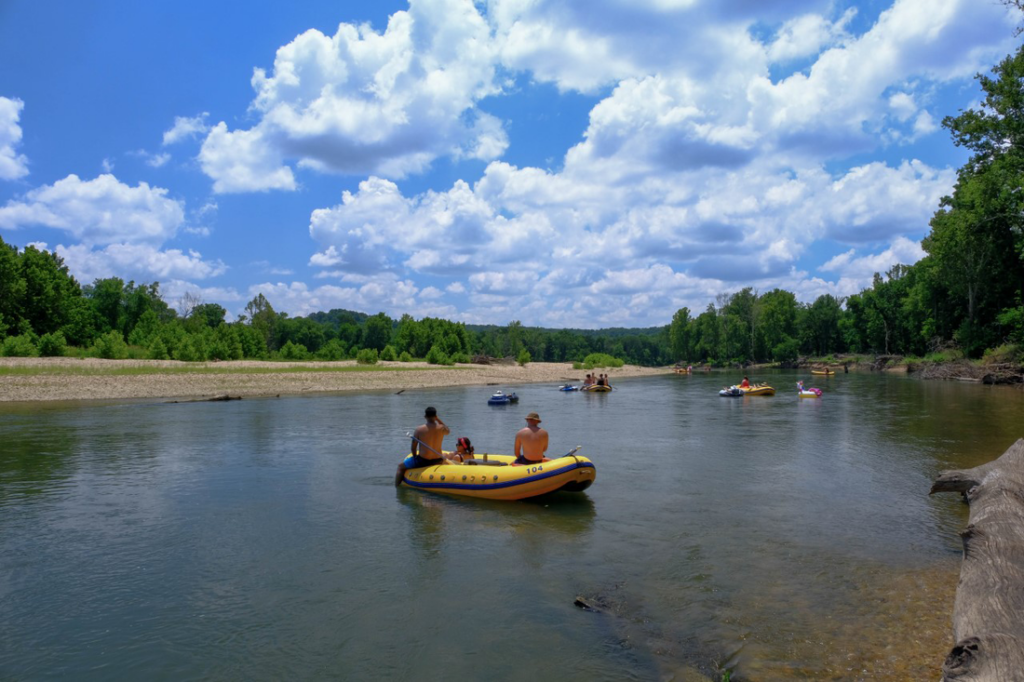
Rafts seat four, six or eight depending on the operator. Diamondhead takes ages 2 and up. Illinois River Outfitters runs six-person rafts with a four-person minimum charge on weekends.
Canoes typically hold three. Peyton’s Place, Arrowhead and War Eagle all rent them. All American Floats runs its 14-mile route as canoes and kayaks only — no rafts.
Kayaks come single, tandem and sit-on-top. Diamondhead sets the kayak minimum age at 10. Illinois River Outfitters notes that children float free in a raft, one per paid floater, but not in a kayak.
Tubes are the slowest option and not every operator offers them. Eagle Bluff rents tubes for a weekday half-day only, at $25 per person.
Where floats are priced publicly, Illinois River Outfitters lists $24 to $35 by trip and day, and Diamondhead lists $20 on weekdays, $34 for the short trip and $38 for the long trip.
Shuttles are normally included in a rental. If you bring your own boat, the shuttle may be a separate charge: Illinois River Outfitters publishes Edmondson $20, Peavine $25, Round Hollow $35 and Chewey Bridge $50, the last two by reservation. All American Floats is not shuttling private equipment in 2026.
What to know before you book either one
Bringing your own boat? You need a GRDA private float permit — $1 per vessel per day, or a $10 annual decal good January through December. Private vessels launch at Peavine or Round Hollow.
Cooler rules are enforced. GRDA limits ice chests to 52 quarts or less, and they should latch shut. Glass and styrofoam are prohibited on the river and the gravel bars.
Spirits are prohibited outright on the Scenic Rivers and in the public access areas — whiskey, rum, vodka, gin, liqueurs and jello shots. Beer and wine in original non-glass packaging are allowed for adults 21 and over while floating and at Peavine, Edmondson, Round Hollow and No Head Hollow. Violations can carry a $206 fine, and anything decanted out of its original container is enough for a ticket.
Life jackets are required by law for children 12 and under, and adults need one in good condition within reach.
Check the water before you drive. Outfitters restrict floats as the Tahlequah gauge rises — Riverbend Floats, for example, stops floating altogether at 7.5 feet. Lodging does not get cancelled for high water; float bookings do. Ask about the float cancellation policy separately.
For what the gauge readings actually mean and how to pick a first trip length, see what beginner-friendly really means on this river.
Frequently asked questions
Yes. GRDA runs public access areas with campsites at $14 per night, and private camps along Highway 10 offer everything from primitive tent sites to full-hookup RV spaces. What you cannot do is camp wherever you like — gravel bars, streambeds and the river itself are off limits.
Sites are first come, first served, and summer weekends fill. A private campground with a reservation is the safer plan for a peak weekend.
Eagle Bluff, Peyton’s Place, Illinois River Outfitters, Arrowhead Resort and The River Bluff Cabins all take RVs, and all sit along N. Hwy 10 northeast of Tahlequah.
A cabin, if the budget allows, mostly for the bathroom and the air conditioning. If you camp, pick a property with showers and a short float.
Yes — at most properties, camping and the float come from the same operator and the same phone call, and you do not need to book a cabin to use their shuttle. One exception worth knowing: Diamondhead expects guests to float with them unless a separate arrangement is made. If you want to camp at one property and float with another, confirm that is allowed before you reserve.
People swim and wade at the gravel bars all season. Two cautions: the current is stronger than it looks after rain, and depths change constantly, so diving is genuinely dangerous. Keep life jackets on children, and do not dive anywhere you have not walked first.
Camping, generally yes, leashed. Cabins, ask — Illinois River Outfitters does not allow pets in theirs.
On and off. Download your playlist before you leave and do not count on data.
Prices current as of September 2026. Rates and rules change; confirm with the property or GRDA before you book.
Explore the Award-winning Visitor Guide

Tahlequah and Cherokee County's official Redbud Award-winning visitor guide packs three days of hikes, floats, rides, and fish into one download. Trip ideas, mileage, and outfitter contacts, ready before you leave home.